

Partnerblog
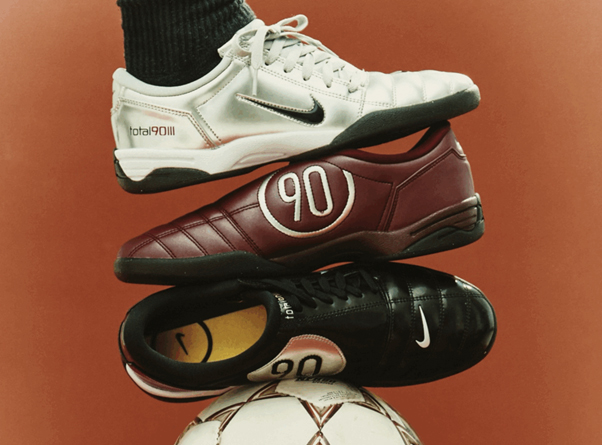
Nike’s Total 90 football boots were among the most iconic sports products of the early 2000s, worn by the likes of Wayne Rooney, Roberto Carlos and Luis Figo. Two decades later, just ahead of the 2026 FIFA World Cup in the United States, the brand is back. Its revival, however, has triggered a complex trademark dispute that holds valuable lessons for trademark owners everywhere.
The backstory
Nike launched the Total 90 line in 2000 and held a U.S. trademark registration for the name. That registration lapsed in 2019 after Nike failed to file the required maintenance declarations with the U.S. Patent and Trademark Office (USPTO).
In 2019, a New Orleans-based engineer and youth football coach began using the « Total90 » name for a fantasy football app. He later set up a company, Total90 LLC, and expanded into clothing and footwear. By 2022, he had applied for two federal trademark registrations, both of which were granted.
Fast forward to 2025: Nike reintroduced the iconic Total 90 line, with plans for a full-scale revival ahead of the 2026 FIFA World Cup. Total90 LLC responded by filing a trademark infringement lawsuit in the U.S. District Court for the Eastern District of Louisiana, arguing that Nike’s use of the name infringes its trademark rights.
Total90 LLC fails to block Nike’s relaunch
Along with its complaint, Total90 LLC sought a temporary restraining order (TRO) to prevent Nike from manufacturing, marketing or selling « Total 90 » footwear while the case proceeds.
The company’s central argument was one of reverse confusion: rather than consumers mistaking Nike’s products for Total90 LLC’s, the claim was that Nike’s massive market presence would lead consumers to assume that Total90 LLC’s products originate from, or are connected to, Nike, thereby diminishing the value of Total90 LLC’s registered mark. In effect, the smaller brand would be swallowed by the larger one.
On 26 November 2025, the court denied the TRO, finding that Total90 LLC had not demonstrated a substantial likelihood of success on the merits nor a substantial threat of irreparable harm. The decision rested on three grounds:
- Use, not registration, creates rights. The court reaffirmed a fundamental principle of U.S. trademark law: rights arise from actual use of a mark in commerce, not from registration alone. Registration provides important procedural benefits, such as a presumption or ownership and nationwide constructive notice, but the underlying right is grounded in use. Applying this principle, the court accepted Nike’s evidence that it had never stopped using the “Total 90” name commercially, even after letting its registration lapse, and found that Nike had not abandoned the mark. Accordingly, the court found that Total 90 LLC had failed to establish itself as the senior user, as priority is determined by use and Nike demonstrated continuous use dating back to 2000. This distinction is significant, as it shows that even where a registration expires, common law rights may persist and protect a mark that has been used continuously.
- No evidence of actual confusion. The court found that Total90 LLC had not presented concrete evidence that consumers were actually confused. Although the trademarks were phonetically and visually similar and both related to football products, there was no proof showing overlap in sales channels or marketing practices between the two companies.
- Delay undermined the urgency claim. Total90 LLC had first contacted Nike about the trademark in December 2024, nearly a year before filing suit. During that period, the parties were negotiating, and Total90 LLC reportedly sought a $2.5 million payment for the trademark rights. The court found that this delay was hard to reconcile with a claim of urgent, irreparable harm.
The case continues
The denial of a TRO is only an early procedural step. The underlying dispute is far from resolved. In January 2026, Nike filed a counterclaim, seeking a declaration that it holds priority over the mark and requesting cancellation of Total90 LLC’s trademark registrations. Nike has accused Total90 LLC of acting in bad faith and of failing to disclose Nike’s prior and continuous use when applying for its registrations at the USPTO.
Total90 LLC, for its part, is expected to argue that the USPTO examined and approved its applications, and that Nike had the opportunity to oppose them but did not. A preliminary injunction hearing has been scheduled, and the outcome could have significant implications for Nike’s World Cup-related product launches.
Lessons for trademark owners
Even though Nike has prevailed at this early stage, the dispute is a cautionary tale. A globally recognised brand found itself in litigation over a name it had used for over two decades, simply because it failed to maintain a registration.
For businesses managing trademark portfolios, the takeaways are straightforward. First, renew registrations systematically. Maintenance filings are low-cost administrative steps that prevent far more expensive problems down the line. Set up internal reminder systems, and do not assume that a lapsed registration has no consequences or that continuous use will always be sufficient. Be aware that certain third parties monitor the public trademark database for cancelled or revoked marks as a business model to register them and later approach the original owners for licensing or purchase.
Second, document ongoing use. If a dispute arises, the ability to demonstrate continuous commercial use of a mark can be decisive. This matters on both sides of the Atlantic: in the U.S., continued use can preserve rights even after a registration lapses, while in the EU, a trademark that has not been genuinely used for a continuous period of five years can be revoked at the request of any third party under Article 58(1)(a) EUTMR. A registration that is not backed by real commercial activity is vulnerable, regardless of which side of the Atlantic you are on.
Third, monitor the register and the marketplace. Had Nike been tracking third-party filings for similar marks, it could have opposed Total90 LLC’s applications before they were granted.
Conclusion
The « Total 90 » dispute is a clear reminder that trademark protection requires ongoing attention. Registration alone does not guarantee protection, and the absence of a registration does not necessarily mean the absence of rights. For trademark owners, the safest approach is a proactive one: renew registrations, keep evidence of use, and monitor the competitive landscape. As this case shows, even the world’s most recognisable brands are not immune to legal uncertainty when trademark maintenance falls short.
Do you need help with the management, enforcement or registration of your trademarks or IP portfolio? Feel free to reach out to us.
Authors
